View this 1964 presidential campaign ad from the Lyndon Johnson campaign. This political ad apparently only ran on TV one time, but was very effective in helping to paint Johnson's opponent, Barry Goldwater, as an extremist.
Your homework (10 points) is to comment to this blog post (first name, last initial, class period) with the following by 11:59pm on Tuesday 4/12/11:
1) discuss (that means with explanation) whether you feel this ad is: A. effective, and B. fair
2) discuss (that means with explanation) your feelings about negative political campaign ads in general
3) find another presidential (or congressional or state or foreign) political attack ad on YouTube that really gets to you (good or bad, funny or sad) and A. describe the ad (what year, what candidates, what issues), B. explain why it got to you, and C. give the YouTube URL so that others might enjoy it . . . keep it clean and unique!
Good Luck!
Wednesday, April 6, 2011

Monday, March 21, 2011
The Test to End All Tests . . . This Quarter, Anyway!

- be on Thursday 3/24/11
- be 80 multiple choice questions, with your best 70 graded (aka, "10 bonus questions")
- cover everything in USA history from the time when there wasn't a USA (dinosaurs perhaps, or at least pre-Columbus) through the 1950s (Eisenhower notes)
- be the last grade for the third quarter
Things to Study (in rank order of importance):
- your Unit Tests from 23-26, 27-28, 29-1/2 30, 1/2 30-31, 32-34, 35-36
- your notes on the Cold War, and on Eisenhower
- your Semester 1 Final Exam
- your Quarter 1 Comprehensive Test
- your prayer manual (if you have one)
Good Luck . . . and don't be like Phillip!
Thursday, March 17, 2011
McCarthy vs. the Army, 1954 . . . Army 1, McCarthy 0!
This is an edited exchange between legal counsel for the army Joseph Welch and Senator Joe McCarthy (R-Wisconsin) on June 9, 1954 during the height of the Second Red Scare.
This is credited by many as the moment where McCarthy began to lose his power and influence, as the hearings were broadcast on TV (this was day 30 of the hearings), and people got to see how McCarthy behaved while accusing Fred Fisher, one the young lawyer's at Welch's law firm, of being a part of the National Lawyer's Guild (a group J. Edgar Hoover had sought to label as a communist-front group) while Fisher had been in law school . . . enjoy (it starts getting good around the 2:30 minute mark).
This is credited by many as the moment where McCarthy began to lose his power and influence, as the hearings were broadcast on TV (this was day 30 of the hearings), and people got to see how McCarthy behaved while accusing Fred Fisher, one the young lawyer's at Welch's law firm, of being a part of the National Lawyer's Guild (a group J. Edgar Hoover had sought to label as a communist-front group) while Fisher had been in law school . . . enjoy (it starts getting good around the 2:30 minute mark).
Are you . . . Guilty by Suspicion (HW)?
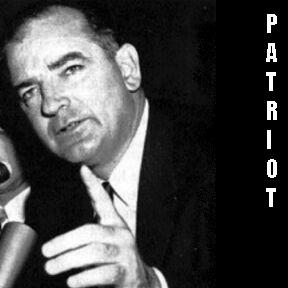

The era of HUAC and McCarthy . . . ponder the following questions and add a comment (with some in-depth explanation!) that addresses at least two:
1) Should people be held accountable today for their words, actions, and personal associations (aka, "friends") from 10 or more years ago?
2) Would you rat out your friends to keep yourself from getting into trouble?
3) Are you now, or have you ever been, a communist (look it up if your confused on what a communist/communism might be)?
4) Was McCarthy a patriot or a villain?
Good luck!
This is due by 11:59pm on Tuesday 3/22/11.
First name, last initial, class period.
10 points.
Thursday, March 10, 2011
Top Secret Extra Credit Opportunity!

By Sunday 3/13/11 at 11:59pm comment to the following post (first name, last initial, class period) . . . share this 2 point extra credit opportunity ONLY WITH THE COOL KIDS!
Background:
During World War II (and World War I), citizens and businesses were asked to sacrifice for the war effort . . . .


Other propaganda encouraged people to plant Victory Gardens . . .

Or encouraged people to buy War Bonds . . . .

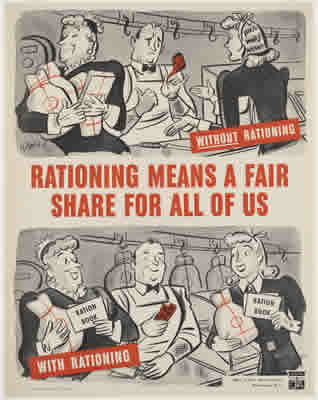
Rationing was also a major part of people's lives . . . .
And now for your questions . . .
Since we are currently involved in two "wars" (Iraq and Afghanistan):
- What one thing would you be willing to give up/sacrifice in order to help support these "wars?"
- How would giving that thing up help the war effort?
Your life is unique, so your answer should be unique, as well!
Good Luck!
Wednesday, March 9, 2011
Another #*@&#* Test!?!? Yes . . . WWII!
Monday 3/14/11 . . . ~40 points, including a special timed reading section . . . DBQ and binder check Tuesday 3/15/11 . . . you're welcome!
How about a video first? If you are a history buff, you might like this YouTube clip of a PowerPoint on WWII in Europe.
1) Who, or what, was "America First" during World War II?


 5) Read the document below:

 8) Does the term "appeaser" have a positive or negative connotation? What is the cartoonist implying in this cartoon, and who might "the appeaser" be (the cartoon was published August 13, 1941)?

How about a video first? If you are a history buff, you might like this YouTube clip of a PowerPoint on WWII in Europe.
Now check out some documents, cartoons, etc.!
1) Who, or what, was "America First" during World War II?


2) Who is napping in this cartoon, and what woke him/her/it up?

3) What does the cartoonist see as a problem in the USA during the war? How does this cartoon relate to the next cartoon?

4) What is a "5th Column?" What can you infer about the cartoonist's feelings toward Japanese-Americans during World War II from this cartoon? How does this cartoon relate to the previous cartoon?

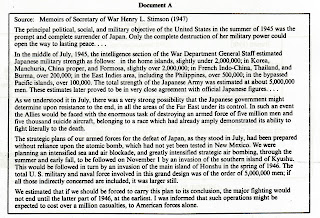
- Where did Stimson feel the strength of the Japanese lay in the summer of 1945?
- What fears did Stimson have about the Japanese government?
- What did Stimson feel was the likely outcome of the war if the atomic bomb were not used?
- What is the main message Stimson was trying to put forward regarding the use of the bomb?

6) Read the document below:
- How did Truman justify the use of the atomic bomb against the Japanese?
- Why was he giving this address?

7) Read the documents below:
- What is the conclusion Arnold came to about the condition of Japan before the use of the atomic bomb?
- Did Eisenhower agree or disagree with Arnold's assessment of the condition of Japan?
- What was the point Eisenhower was trying to make about why it was, or was not, necessary to use the atomic bomb?


9) For an animated map and some basic information on the Holocaust, click here.
10) And last, but not least, Donald Duck goes to war (1943) . . . check out the good duck/bad duck routine . . . how does this relate to the "Zoot Suit Riots" in Los Angeles?
10) And last, but not least, Donald Duck goes to war (1943) . . . check out the good duck/bad duck routine . . . how does this relate to the "Zoot Suit Riots" in Los Angeles?
Subscribe to:
Posts (Atom)